|
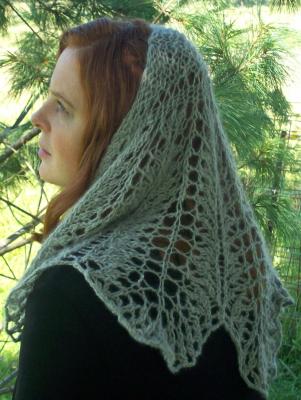
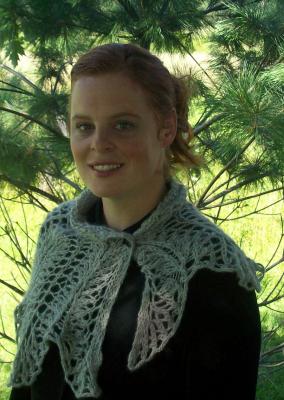
It is also quite lovely to wear as a little shawlette, scarf, or as a pretty head cover to keep ears toasty. It is not wind resistant because of the lacy texture, but will still lend some warmth to chilly ears on cool days. Personally, I think it would make a fabulous sleeve for a lace sweater or shrug, hmm... maybe next issue. Yarn: The yarn was spun from 2.5 oz 50% wool, 50% angora blended roving. It was spun to a fingering weight of about 15 wraps per inch, and I used about 150 yards for this small veil. Any weight could be used, with the right needle size to get a nice drapey fabric. Needles and notions: I used size 10.5 needles, and a light fingering weight yarn, you can use almost any lighter yarn, just match your needles to get the type of fabric you want. Pattern notes: I suggest knitting one repeat of the pattern as a swatch to see how you like the result, and in the meantime you will memorize the pattern, and you can estimate your yardage requirements, simply multiply the yards you used by 6. This is extremely easy to knit, and worked up very fast. It is a perfect pattern for the knitter who knows their way around, but hasn't gotten into lace yet. I will warn you, I made this, so if there's a mistake, or you are totally confused or messed up, email me, I'll help you, fix the pattern or whatever I can do. The beginning is an odd one, using short rows. This gives the veil a nice firm place to pin to your hair. You could begin in many other ways, but this was the easiest way I could think of to get a half circle started.
Abbreviations: co - cast on; sts - stitches; sl1 - slip one; pm - place marker; rm - remove marker; yo - yarn over; k2tog - knit 2 together; Instructions: R1: co 27 sts, sl1, k1 and place a marker (pm), k24 (leave the last stitch unknitted), turn work. (2,24,1) R 2: sl1, pm, k23, turn.(2,23,2) R 3: rm,sl1, pm, k22, turn.(3,22,2) R 4: rm, sl1, pm, k21, turn.(3,21,3) R 5: rm, sl1, pm, k20, turn.(4,20,3) R 6: rm, sl1, pm, k19, turn(4,19,4) R 7: rm, sl1, pm, k18, turn.(5,18,4) R 8: rm, sl1, pm, k17, turn(5,17,5) R 9: rm, sl1, pm, k16, turn.(6,16,5) R10:rm, sl1, pm, k15, turn. (6,15,6) R11:rm, sl1,pm,k14,turn.(7,14,6) R12:rm, sl1,pm,k13,turn.(7,13,7) R13:rm, sl1,pm,k12,turn.(8,12,7) R14:rm, sl1,pm,k11,turn.(8,11,8) R15:rm, sl1,pm,k10,turn.(9,10,8) R16:rm, sl1,pm,k9,turn.(9,9,9) R17:rm, sl1,pm,k8,turn.(10,8,9) R18:rm, sl1,pm,k7,turn.(10,7,10) R19:rm, sl1,pm,k6,turn.(11,6,10) R20:rm, sl1,pm,k5,turn.(11,5,11)
The goal here is that you want a space that was made by the short row on either side, and a yarn over between each stitch in the center section. I have changed this several times, and it may not be clear no matter how I write it. So look at the work and just do what you need to have a gap between each stitch. The yo will be dropped off later to create a gap to match the short row gaps.
Because of inconsistancies, again look at the work and don't worry too much as long as you have 27 stitches total and a gap between each it's fine. Do what you need to to to make that the result.
R 24: k3, [yo, k1] 21 times, yo, k3. (49 stitches, ws) R 25: k45, k2tog, k2. (48 sts,rs) R 26: k3, pm, *p7, pm, repeat from * 6 times to last 3 sts, pm, k3. (48sts, ws) R 27: knit across. (rs)
Ok, phase one is completed. For clarity, we will number the next rows beginning with row 1. I don't know about you, but, I'm pleased with the look of the beginning. This first part can give a lot of people not familiar with short rows some pause for thought, but it really does make sense eventually!
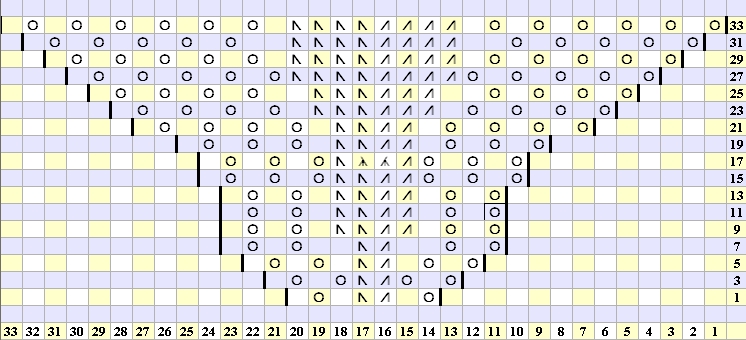
Now we will begin working from the chart. For those of you who are unfamiliar with charts, I don't think there is a better pattern to learn on. There are only 5 stitches to remember, and they are easy ones to identify. A plain square means knit, a circle means yarn over, a line slanting to the right means knit two together. If you think about it, that makes sense, because you know that k2tog slants to the right, right? So slanting to the left means slip one as if to knit, knit one, pass the slipped stitch over. There are a few double decreases that are in there, but they are not hard either. Simply knit 3 together, for the right side, and slip one, k2tog pass the slipped stitch over for the left one. Each row will start and end with knit three. So you will knit three, do six pattern repeats, then knit three. All purl rows are knit three, purl to last three, knit three. You can also knit the purl rows for a lovely scallop effect. For a larger shawl, insert a plain knit row between each chart row, so for example, R1: K3, knit row one from the chart, knit 3. R2:THen K3, purl across, K3. R3:Knit across, R4: K3, purl across, K3. R5, do row 2 from the chart. This will give you a much larger shawl, but will still look the same pattern wise.
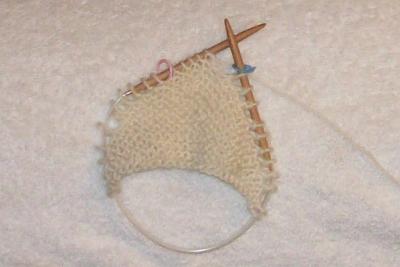
Download written instructions here The chart repeats six times, and there are no side chart areas, but you will knit the first and last three stitches on each row, to make a border That's it, surely those of you who aren't chart experts can try this. The pattern repeats so nicely, that a lost stitch or mistake is easy to find, and easy to fix. I think you will like it, if you've never worked with lace, or a chart before. Those of you who have can stop rolling your eyes now, I'm done. Here is the veil after just 9 rows!
Once you have completed the chart, you can knit one row plain in one needle size larger, then do a crochet bind off, or knit on a lace edging. |